
Part I:
What is Managed Care?
Managed care is rapidly becoming the dominant form of healthcare delivery
and financing in the United States. Managed care has the ability to manage
the cost and quality of healthcare services, while balancing access to that
care through the use of the essential "building blocks", such
as utilization management procedures, quality assurance protocols and information
system capability.
It is important to keep in mind that the definition of managed care is constantly
changing. How managed care is defined today, may not be how it is defined
in the future.
Once, managed care meant HMO care, and an HMO was defined as a pre-paid
organization that provided healthcare to voluntarily enrolled members in
return for a pre-set amount per member per month. Now, however, the meaning
of managed care has expanded to include almost any form of coverage that
limits the member's ability to choose any provider and to self-refer throughout
the healthcare system.
Managed care encompasses a broad spectrum of models for care delivery
and management. Several types of managed care organizations (MCOs) have
evolved. A listing of the most common types of managed care organizations
is provided in Appendix A.
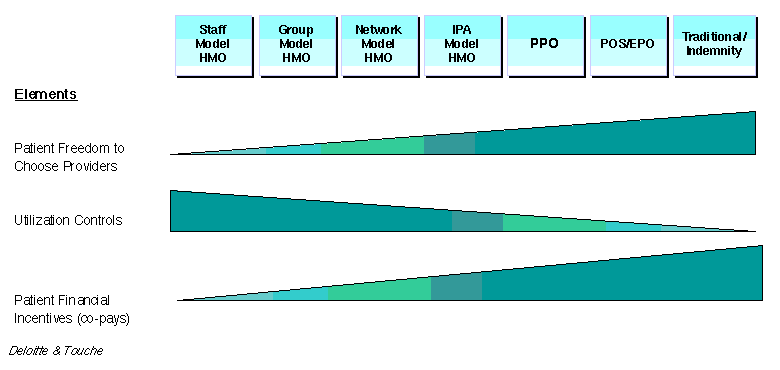
Each type of MCO may define managed care differently; it depends on the
level of emphasis that the managed care organization places on each of the
essential "building blocks".
Three essential "building blocks" include:
Freedom of Choice: the level of freedom the patient has to choose
his/her healthcare provider
Utilization Controls: the use of utilization management programs
to control the volume and type of services utilized
Patient Financial Burden (co-pay & co-insurance): what the benefits
are, how the benefits are designed, and what financial incentives are put
in place for a member to choose one provider over another.
Every managed care company uses a planned and coordinated approach to
providing healthcare with the goal of quality care at a lower cost.
What Has Led to the Growth of Managed Care?
Now that we have defined managed care, let's review the forces that
have led to the growth of managed care.
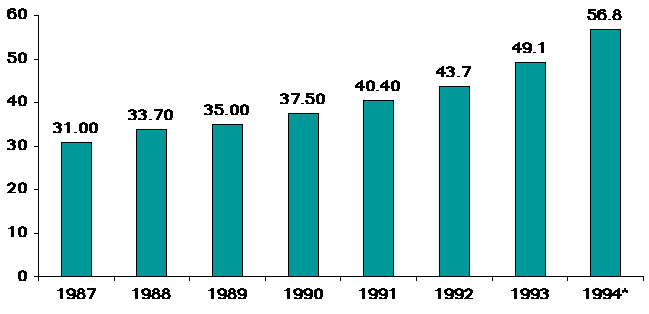
Source: Marion Merrell Dow Managed Care Digest/HMO Edition 1994
* Annualized based on 6 months of data
As this slide shows, in 1994, HMOs enrolled almost 57 million members, which
represents approximately 20% of the U.S. population. Growth in enrollment
is expected to continually increase.
There are three main forces contributing to the growth of managed care:
- Demand for lower costs
- Demand for higher quality care
- Demand for greater accountability for that care
American employers, who pay a large part of the health care
bill, are shifting its workers into managed care plans in an effort to help
control their costs and improve the quality of care.
The changes in healthcare are in response to the demands of employers, business
coalitions, the government and general public. But the changes are occurring
at different rates in different geographical markets across the country.
The challenge is to apply an understanding of broad managed care concepts
to specific situations in local markets in order to identify opportunities
for your hospital.
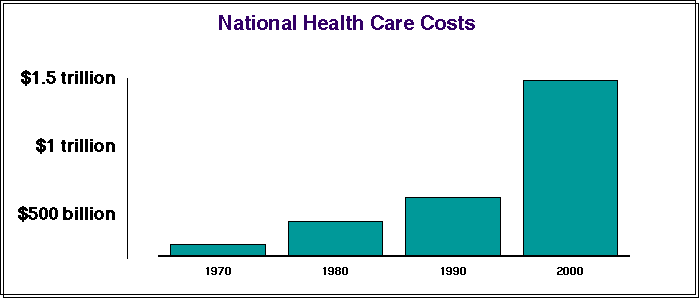
The Douglas Group, Health Care Consultants
Healthcare costs in the United States have been increasing at a rapid rate.
The U.S. Commerce Department reported that the $838.5 billion spent on healthcare
in 1992 accounted for greater than 14% of the total economic output for
the U.S. The Commerce Department projects that medical spending will continue
to rise 12%-15% per year for the next five years unless significant changes
in the system take place.
Up until the 1980s, the healthcare environment was one of expansion.
The number of hospitals and providers grew. The predominate form of
medical insurance was fee-for-service which covered everything,
and patients had complete freedom of choice.
In the 1980s, an era of cost containment began. New forms of reimbursement
were introduced, such as Medicare's prospective payment system, commonly
referred to as DRGs (Diagnostic Related Grouping). This was the first attempt
to share risk between providers and payers.
In the 1990s, an era of assessment and accountability began. Providers
are beginning to be held accountable for the quality and cost of the services
they provide. The risk for the cost of care is beginning to be shared through
prospective payments and capitation.
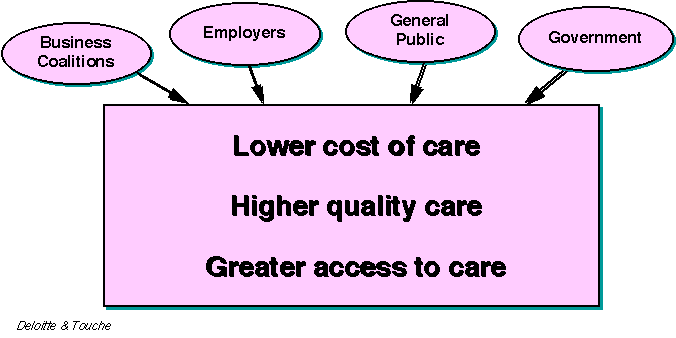
Business coalitions, employers, the general public and government are all
demanding:
Lower Cost of Care:
Why, because healthcare costs in the U.S. have been increasing at a rapid
rate. Historically, several important factors have contributed to the upward
spiral of healthcare costs, such as:
- broad insurance coverage has encouraged consumers to use medical
care with little regard for price
- insurance companies have passed on the costs of this increased use
to employers in the form of premium rate hikes
- the rapid introduction of high technology medicine
- faced with increased competition, most hospitals have felt the pressure
to provide a full range of services, even those requiring significant investments
in equipment. This has forced hospitals to charge higher prices to cover
these expensive investments.
Demand for higher quality care and greater accountability:
The government, employers and the general public are not only demanding
lower costs for health services, but are also demanding greater access to
care, and the ability to measure outcomes of this care.
What Are Managed Care Organizations' Objectives?

Throughout the healthcare system, many actions are being taken to gain more
control over the delivery of care in anticipation of more market changes.
The influence of managed care continues to expand in the face of continued
pressures to bring down costs.
In order to effectively respond to the changing healthcare environment and
prosper under managed care, every hospital and its employees must understand
the goals of managed care organizations.
Managed care organizations have several objectives. They must perform
a balancing act. On one side of the scale, managed care organizations want
to maintain quality by:
- maximizing the patient's choice of providers
- offering a comprehensive breadth of service options
- offering the highest quality providers in their network
On the other side of the scale, managed care organizations are
focused on controlling costs by:
- directing patients to cost-effective providers
- providing care in less intensive and appropriate settings
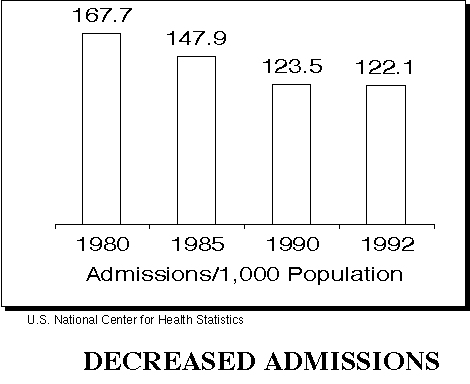
What does this balancing act mean to hospitals?
In the short-term, managed care organizations attempt to control utilization
of hospital services has resulted in decreased hospital admissions.
Reducing hospital use offers the greatest opportunity for controlling costs.
Overall, hospital costs usually account for greater than 40% of the medical
expenses for most managed care plans.
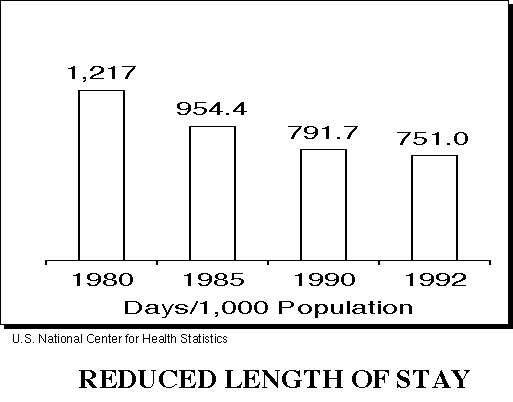
While the growth of managed care has pushed down hospital utilization rates,
the observable short-term outcome has been a continual reduction in hospital
length of stay.
For example, HMOs' utilization controls have succeeded in cutting the number
of inpatient days in half without evidence of compromised patient care.

In the long-term, Managed Care Organizations (MCOs) have several ways to
restrain hospital costs. Commonly employed methods include:
- Tracking and analyzing the economic performance of their participating
providers
- Setting fees for specific medical procedures
- Reimbursing hospitals for their services in ways that make the MCO's
pay-outs as low as possible
- Changing provider incentives to force hospitals to bear more financial
risk for the services the hospital provides
Most hospitals are currently trying to learn how to bear the financial risk
for the services they provide without losing money.