Management's Discussion and Analysis Of Financial Condition and Results
Of Operations
Results of Operations
In 1995 the Company attained sales of $1.02 billion compared with sales of $919 million in 1994 and $1.04 billion in 1993. Sales increased $ 104 million or 11 % in 1995, decreased $119 million or 11 % in 1994 , and decreased $160 million or 13 % in 1993. In 1995 the Company reported net income of $79 million or $1.05 per common share (after preferred stock dividends of $20 million), compared with net income of $ 19 million or $.08 per common share (after preferred stock dividends of $15 million) in 1994, and a net loss of $139 million or $2.48 per common share in 1993. Net income and net income per common share increased $60 million and $.97, respectively, in 1995 compared to 1994, increased $158 million and $2.56, respectively, in 1994 compared to 1993, and decreased $278 million and $4.80, respectively, in 1993 compared to 1992. The effect of changes in foreign currency exchange rates on results of operations was to increase net income by $14 million in 1995 in comparison to 1994. The effects of foreign currency exchange rate changes on net income in 1994 and 1993 were immaterial.
The Company recorded restructuring charges of approximately $7 million during the second half of 1995 that relate primarily to lease terminations and employee severance costs associated with the relocation of one of the Company's largest international subsidiaries and the plan to centralize the distribution of the Company's products to its European customers. In addition, severance payments were incurred in relation to the restructuring of the Company's manufacturing plants. The majority of the cash outlays relative to these restructuring charges were made during the third and fourth quarters of 1995, with the remainder to be made by the end of the first half of 1996. The 1995 restructuring charges were basically offset by the reversal of restructuring cost estimates in excess of ultimate costs which were originally recognized in the Company's fourth quarter 1993 consolidated financial statements.
In the second half of 1993 the Company adopted a restructuring plan designed to reduce its cost structure and improve its competitive position through property divestitures and consolidations and a reduction in its management, administrative, and direct labor workforce. These plans were adopted when it became apparent that projected worldwide sales growth did not meet Company expectations. The Company initially announced plans to layoff approximately 700 administrative staff personnel, close its manufacturing plants for thirteen days in the fourth quarter of 1993, and adopt a four day work week for certain manufacturing employees during the early part of 1994. The Company expanded upon its restructuring plans in 1993 to include real estate divestitures and consolidations and additional employee voluntary and involuntary severance programs. Substantially, all payments under these severance programs have been completed by December 31, 1995.
Restructuring charges recorded in 1993 were $138 million ($130 million or $2.31 per share net of taxes). These charges consisted primarily of writedowns of certain real estate to estimated net realizable value ($ 79 million), provisions for lease buyout expenses ($24 million), accruals for severance costs ($30 million) and write down of other assets ($5 million). The Company has either terminated or bought out the leases of the leased properties and paid substantially all employee severance costs which were part of the 1993 restructuring charges.
The increase in sales in 1995 to $1.02 billion compared to $919 million in 1994 was primarily due to volume increases and the Company's initiation of direct distribution of its products to Japanese customers through the acquisition of certain assets from the Company's former Japanese distributor. The reduction of inventories at JIT distributors during 1995 had a negative impact on sales as hospital purchases from JIT distributors exceeded distributor purchases from the Company by $13.1 million (1994 - $28.2 million). Changes in the health care industry continue to significantly affect the Company's marketplace. Industry consolidations, intense competition, and pricing pressures due to ongoing reform of the health care system have continued in 1995. The rate of acceptance of newer procedures utilizing the Company's products also continues to be affected by uncertainty surrounding health care reform and by the increased educational requirements for more complex procedures. The reduction in sales to $919 million in 1994 from $1.04 billion in 1993 was significantly affected by the initial distributor stocking program in early 1993 which was not repeated in 1994. Distributor inventory purchases were made in connection with the implementation of the Company's JIT domestic hospital distribution program during the first quarter of 1993. The initial stocking of the JIT distributors precipitated an inventory reduction period during which hospitals formerly supplied directly by the Company worked their inventories down and distributors adjusted their own inventories.
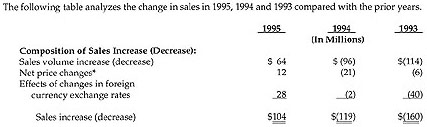
* Approximately $36 million of the sales increase for the year ended December 31, 1995, accounted for in net price changes above, is the result of the 1995 acquisition of certain assets from the Company's former distributor in Japan.
Sales volume increases and the effects of foreign currency exchange rate fluctuations accounted for 62% and 27%, respectively, of the total 1995 sales increase compared with 1994 and 81% and 2%, respectively, of the total 1994 sales decrease compared with 1993.
Gross margin from operations (sales less cost of products sold divided by sales) was 56% in 1995 and 50% in 1994 and 1993. Although the Company implemented the majority of its restructuring plans during the last quarter of 1993 and the first quarter of 1994, the major benefits of the cost reduction measures adopted by the Company did not start being realized in reduced cost of product until 1994, which resulted in improved quarterly gross margins as the applicable product was sold in the second half of 1994. Gross margins continued to improve in 1995 as a result of the implementation of the 1993/1994 restructuring plans. Gross margins in 1993 compared to 1992 were negatively impacted by higher costs associated with the increase in production capacity, the introduction of new products and increases in related inventory and fixed asset reserves from the consequent obsolescence of production tooling and inventories and additional selling price discounts granted to JIT distributors with the implementation of the JIT distribution program. The reserves for obsolescence of production tooling and inventories, which are an ongoing cost of business, amounted to $45 million, $61 million and $62 million, respectively, in the years ended December 31, 1995, 1994 and 1993. The effects of foreign currency exchange rate changes on cost of products sold in 1995 and 1994 were immaterial. Changes in foreign currency exchange rates from those existing in 1992 had the effect of reducing cost of products sold by $18 million in 1993.
The Company's investment in research and development during the past three years (1995 - $43 million; 1994 - $38 million; 1993 - $51 million) has yielded numerous product improvements as well as the development of numerous new products. The increase in research and development expense in 1995 compared to 1994 resulted primarily from $4.6 million of charges during the third quarter of 1995 related to certain technologies which the Company decided not to pursue. The decrease in research and development expense in 1994 compared to 1993 reflects the impact of a program initiated in the second half of 1993 to increase efficiency and reduce the cost connected with the pilot development of new products which are classified as research and development. The Company is continuing its commitment to develop and acquire unique new products for use in new surgical procedures and specialty areas.
Selling, general and administrative expenses expressed as a percentage of sales were 41% in 1995, 40% in 1994, and 43% in 1993. The increase in selling, general and administrative expenses as a percentage of sales in 1995 is primarily due to the effects of the initiation by the Company of the marketing of the Company's products to its Japanese customers as a result of the acquisition of certain assets from the Company's former Japanese distributor. The decrease in selling, general and administrative expenses as a percentage of sales for 1994 results from the major cost saving benefits from the Company's restructuring program in the form of reduced selling, general, and administrative expenses as a percentage of sales throughout 1994. The percentage increase in 1993 resulted primarily from higher depreciation and amortization charges related to the Company's facilities expansion. Changes in foreign currency exchange rates from those existing in the prior year had the effect of increasing selling, general, and administrative expenses by $13 million in 1995, and decreasing selling, general, and administrative expenses by $6 million in 1994 and $21 million in 1993.
The tax provisions for 1995, 1994 and 1993 related primarily to foreign taxes including taxes in Puerto Rico. The Company's tax provisions in 1995 and 1994 reflect the lower effective tax rates on a subsidiary's operations in Puerto Rico and the availability of a tax credit under Section 936 of the Internal Revenue Code and the tax benefit of certain net operating loss and tax credit carryforwards which were not previously considered recognizable. The 1993 tax provision is a result of the Company incurring net operating losses in certain tax jurisdictions for which the Company was not able to recognize the corresponding tax benefits.
In August 1995, the Company reached agreement with respect to settlement of all issues raised by the Internal Revenue Service (IRS) in its examination of the Company's income tax returns for the years 1984 through 1990. Prior to this resolution, a significant portion of deferred tax assets related to available net operating loss and tax credit carryforwards had been fully reserved by the Company because of uncertainty over the future utilization of the tax benefits. Based upon current circumstances relative to the IRS audit and the Company's estimate of future domestic taxable income, it now appears more likely than not that a significant portion of such fully reserved assets will be realized in the future. As a result, in the third quarter of 1995 the Company reduced the valuation allowances related to a significant portion of these deferred tax assets by $54.3 million (change in valuation allowances in 1995 was a reduction of $75.6 million), increased its current tax liabilities by $28.6 million for the remaining estimated tax liabilities relating to years subsequent to 1990, decreased tax assets by $7.4 million, recognized a net credit to the tax provision of $10.0 million ($.18 per common share) and recorded a credit to Additional Paid-in Capital (for windfall tax benefits related to net operating losses generated from stock compensation deductions in prior years) of $8.3 million.
The Company will adopt the provisions of Statement of Financial Accounting Standards No. 123 "Accounting for Stock-Based Compensation" (FAS 123) in the first quarter of 1996. The Company, as provided for by FAS 123, will continue to apply Accounting Principles Board Opinion No. 25, "Accounting for Stock Issued to Employees" for employee stock compensation measurement. The anticipated effect of adopting this new standard is not expected to have a material effect on the Company's consolidated financial position or results of operations.
Financial Condition
The increase in accounts receivable results from the $37 million increase in sales in the fourth quarter 1995 when compared to the fourth quarter 1994.
The increase in other current assets and income taxes payable results from the Company's settlement with the Internal Revenue Service referred to above.
The increase in other assets results primarily from an increase in goodwill ($64 million) and patents ($18 million) resulting from the Company's acquisition of Japanese distribution rights from the Company's former Japanese distributor and the business combination with Surgical Dynamics, Inc. (see Note C of Notes to Consolidated Financial Statements).
The Company's current cash and cash equivalent balances, existing borrowing capacity and projected operating cash flows are currently in excess of its foreseeable operating cash flow requirements. Following the issuance of $200 million of convertible preferred stock in March 1994, the proceeds from which were used to reduce bank debt, the Company entered into a new $400 million syndicated credit agreement in June 1994, later reduced to $350 million in the first quarter of 1995 as a result of the strong cash flows currently being generated by the Company.
The Company terminated its existing syndicated credit facility which was scheduled to mature in January 1997 and entered into a new $325 million credit agreement in December 1995. This new credit agreement matures January 2001 and provides for certain covenants similar to the credit agreement it replaced, such as restrictions on asset sales, common stock dividends in excess of 20% of net income and subsidiary debt as well as required maintenance of certain minimum levels of tangible net worth and fixed charge coverage ratios and a stipulated level of debt to total capitalization. The new credit facility provides for borrowings up to $25 million worth of Japanese Yen within the facility. During 1995, the Company entered into uncommitted Japanese Yen credit agreements with two Japanese banks for a total of 3 billion Yen (approximately $30 million) in order to enhance liquidity for its Japanese subsidiary. Additionally, the Company had $50 million of uncommitted credit agreements with three other domestic banks. The Company is in full compliance with all of its covenants associated with its various bank and leasing agreements.
The Company's building programs have been essentially completed, which enabled the Company to reduce its capital spending by more than 28% in 1995 compared to 1994 levels and 78% in 1994 compared to 1993 levels. Additions to property, plant, and equipment on the accrual method totaled $48 million ($34 million on a cash basis) in 1995, compared with $49 million in 1994, and $187 million in 1993, and consist of additions to machinery and equipment ($25 million), molds and dies ($11 million) and land and buildings ($12 million). During 1995 the Company removed from its balance sheet, property, plant, and equipment which had an original cost of $27 million and is now fully depreciated and out of service.
The change in long-term debt at December 31, 1995 in comparison to the prior year-end reflects the notes payable related to the acquisition of Japanese direct distribution rights and the cash flow generated from operations which enabled the Company to reduce bank debt by $37 million after recognizing the effect of over $80 million of business acquisitions during 1995.
The Company routinely enters into foreign currency exchange contracts to reduce its exposure to foreign currency exchange rate changes on the results of operations of its international subsidiaries. As of December 31, 1995 the Company had approximately $25 million of such contracts outstanding that will mature at various dates through February 1996. Realized and unrealized foreign currency gains and losses are recognized when incurred. The weakening of the dollar relative to most foreign currencies caused the $10 million movement in the Company's Accumulated Translation Adjustments component of Stockholders' Equity at December 31, 1995 compared to the prior year.
The Company's North Haven facilities are leased from a trust, of which the original developer (the "Owner Participant") holds the beneficial interest. The Owner Participant has the right to require the Company or the Company's designee to purchase the Owner Participant's beneficial interest. This right cannot be exercised by the Owner Participant until January 1998 and continues for a period of four years thereafter. The Company's obligation, if the right is exercised, would be to take title to the beneficial interest in the trust, or find another investor, suitable to the noteholders who financed these facilities, to take such title. In either case the Company's obligations as lessee under the lease would not change. The Company would be obligated, whether or not the right is exercised, to make payments called for under the existing lease of approximately $57 million annually through the year 2002, a payment of $28 million in January 2003 and nominal annual payments of $100,000 through 2022. In addition, the Company may be obligated to make an additional payment of approximately $19 million if the right is exercised which could be payable as early as January 1998, or ratably throughout the remaining term of the lease. The foregoing amounts in the preceding two sentences represent cash flow impacts whereas the rent expense would aggregate less than $20 million per year.
If, as described above, the Company takes title to the beneficial interest in the facilities in 1998, it is estimated that the Company's balance sheet would be affected through an increase in property, plant and equipment of $339 million, a decrease in other assets of $109 million and an increase in Long-Term Debt of $230 million.
CAUTIONARY STATEMENT
Certain statements contained in the Chairman's letter, the proxy statement, and the Annual Report to Stockholders are forward looking. Many factors could cause actual results to differ from these statements, including loss of market share through competition, introduction of competing products by other firms, pressure on prices from competitors and/or customers, regulatory obstacles to introductions of new products, lack of acceptance of new products by the health care market, slow rates of conversion by surgeons to procedures which utilize the Company's products, changes in the healthcare market, changes in distribution of the Company's products, influence of health maintenance organizations and group purchasing organizations, and interest rate and foreign exchange fluctuations. Such factors are discussed in detail in the Company's filings with the Securities and Exchange Commission.