|


UNITED STATES SURGICAL CORPORATION (USSC) was founded on the concept
of providing an innovative and cost effective new technology for health
care. During its three decades, the company has remained faithful to this
mission.
Surgical Stapling
| The first mechanical tissue closure device was developed by a Hungarian
surgeon in 1908; it weighed eight pounds and took two hours to assemble
and load. Subsequent surgical staplers introduced in Germany, Russia and
Japan received minimal acceptance because the devices required cumbersome
hand loading of individual staples with a magnifying glass and tweezers. |
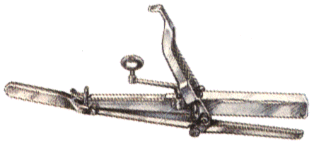
Hültl stapler, circa 1908 |
| In 1967, USSC introduced the first practical surgical staplers. These instruments
contained fine stainless steel staples the diameter of four human hairs,
preloaded in a cartridge that eliminated tedious hand loading. In the intervening
years, the company has expanded the concept of surgical stapling from a
little known medical curiosity to a major tool for improved patient care.
Today, USSC's AUTO SUTURE instruments have applications in a broad
range of surgical procedures. |

| The GIA instrument (left and center) simultaneously
cuts and closes tissue. This stapler was later
adapted for use in laparoscopic surgery (ENDO GIA instrument, right). |
|
Surgical stapling allows surgeons to achieve precision and delicacy in
tissue reconstruction that is difficult to duplicate manually. The instruments
can be used to remove diseased tissue, tie off blood vessels, seal off or
reconstruct organs, join internal tissue and close skin. In some cases,
stapling makes possible procedures that could not otherwise be performed.
For example, one instrument developed by USSC can eliminate the need for
a colostomy, a surgical procedure in which the rectum must be closed permanently,
requiring the patient to wear an external bag for collection of body waste.
Surgical staplers place up to 92 staples simultaneously, reducing tissue
trauma and blood loss by eliminating the need to place individual sutures
one at a time. Operating and anesthesia time can be reduced by as much as
50%. |
| Since surgical staplers facilitate healing, patients frequently have fewer
post-operative complications and shorter hospital stays. |
Laparoscopy
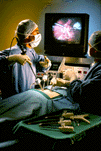 |
In recent years, stapling has been applied to the growing area of laparoscopy,
a form of minimally invasive surgery which has revolutionized surgical care.
Laparoscopic staplers perform the same function as traditional surgical
staplers but are designed to be placed into tiny puncture incisions (up
to one-half inch in diameter) made by an instrument called a trocar. A miniature
camera inserted through one of the trocars allows the surgeon to perform
the procedure while viewing the patient's internal organs on a video monitor.
Laparoscopic surgery, in most cases, dramatically reduces pain, scarring,
hospital stay and recovery time and contributes to lower hospital and post-operative
costs. |
In 1990, USSC introduced the ENDO CLIP applier, making possible
a revolutionary new technique for gallbladder removal. Patients who undergo
this procedure can usually return home within a day of surgery and resume
normal activities within a week. In the past, gallbladder removal typically
involved a week-long hospital stay and four to six weeks of painful recuperation.
The benefits of this procedure are so dramatic that approximately 90%
of the 600,000 gallbladder removals performed annually in the United States
have been converted to the laparoscopic technique. Other instruments in
USSC's laparoscopic line make possible minimally invasive hysterectomy,
appendectomy, hernia repair and kidney removal, as well as treatments for
chronic heartburn, female incontinence and certain lung and bowel disorders.
USSC's new Mini-Site instruments enable surgery to be performed
through very tiny incisions, offering significant patient benefits while
helping to minimize costs. These instruments are being applied to a growing
number of procedures, which can often be performed under local anesthesia
and in an outpatient setting. |
Sutures
 USSC developed a line of technologically
advanced suture materials which were introduced in 1991. Because most surgical
procedures which use staples also require suturing, sutures are a natural
complement to the company's stapling instrumentation.
USSC's new synthetic monofilament suture embodies most of the characteristics
of braided suture, which surgeons prefer because of its superior handling
ability, tensile strength and knot security. However, unlike braided suture,
BIOSYN suture does not promote the migration of bacteria, which creates
a breeding ground for infection.
To strengthen its presence in the hospital market, USSC continues to
expand its product line through research and development, acquisitions and
strategic alliances. New products are creating additional opportunities
in a number of areas including cardiovascular surgery, interventional cardiology,
orthopedic and neurosurgery and women's health care. |
Women's Health Care
One of the company's most exciting new products is the ABBI system
for minimally invasive breast biopsy. The ABBI system, which includes
a stereotactic table for imaging the lesion and a minimally invasive biopsy
device, is an ideal fit with today's health care environment. USSC recently
acquired marketing rights to a proprietary ultrasound visualization technology
intended to broaden the types of lesions that can be biopsied with the ABBI
system. |
Cardiovascular Surgery/Interventional Cardiology
USSC's first major technological breakthrough in the cardiovascular area
was the VCS clip applier for reconnecting of blood vessels. This
device holds the vessel together without penetrating it, eliminating the
potential for turbulence and clotting that can be created by staples or
sutures. In addition, the VCS clip applier dramatically shortens
the time it takes to complete the procedure. |
| The company recently introduced a complete system of instruments for minimally
invasive coronary bypass surgery, which significantly reduce trauma, postoperative
hospital stay and recuperative time. Minimally invasive coronary bypass
surgery using USSC's Mini-CABG instruments involves a three- to four-inch
incision between the ribs instead of the usual 12-inch incision and cracking
of the sternum. The procedure can be performed on a beating heart, eliminating
the risk of blood damage that can result from the use of a heart-lung perfusion
machine. |
 Mini-CABG instrument set |
| USSC is currently conducting clinical trials on other new products for cardiovascular
surgery and for the important area of interventional cardiology, which treats
heart patients by inserting therapeutic catheters into the vascular system. |
Orthopedic and Neurosurgery
Chronic back pain, which afflicts millions of people worldwide, is typically
caused by damaged or deteriorating spinal structures grating against each
other. Until recently, orthopedic and neurosurgeons have used various types
of surgical hardware -- rods, hooks, plates and screws -- to correct this
problem. The results have been mixed. |

Ray Threaded Fusion Cage (TFC) device
|
USSC's subsidiary, Surgical
Dynamics, Inc., recently introduced the Ray Threaded Fusion Cage
(TFC) device, a new technology in implantable spinal devices. It provides
support for the spinal structures during the time it takes for new bone
to grow. The Ray TFC device is relatively easy to implant and reduces
operating time, tissue trauma, blood loss, post-operative pain and recovery
time.
Other products for orthopedic and neurosurgery include a growing family
of products for arthroscopic (minimally invasive) procedures. |
For additional information, contact:
|
Marianne Scipione
Vice President, Corporate Communications
United States Surgical Corporation
150 Glover Avenue
Norwalk, CT 06856 (203) 845-1404
[email protected]
|
Trademarks of USSC and its subsidiaries are italicized. |

 Copyright © 1997 United States Surgical Corporation. All Rights
Reserved.