What is Minimally Invasive Surgery

There's a relatively new approach to surgery that's getting people out of
the hospital sooner and back to their normal activites more quickly
with less pain and, in many cases, lower costs.
You may have heard about or read about it ...or you may even know someone
who has had his or her gallbladder removed and was up an around in just
a couple of days.
The approach, laparoscopy, is also known by several other names, including
endoscopy and minimally invasive or less invasive surgery. No matter what
term you use, the big advantage of this new technique is that there is no
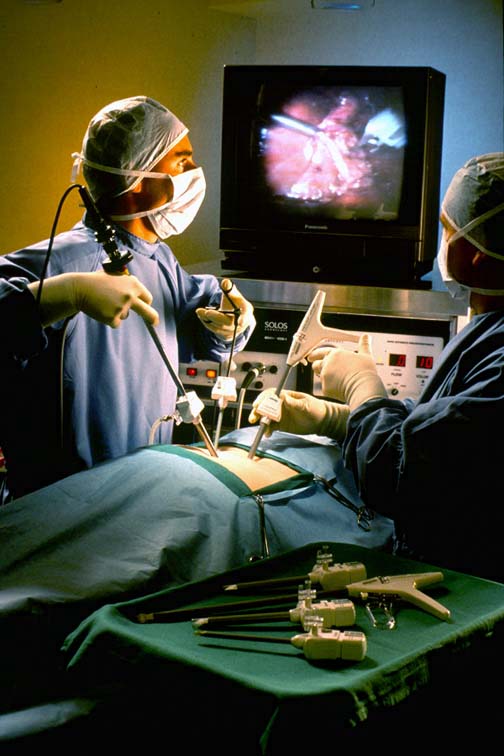
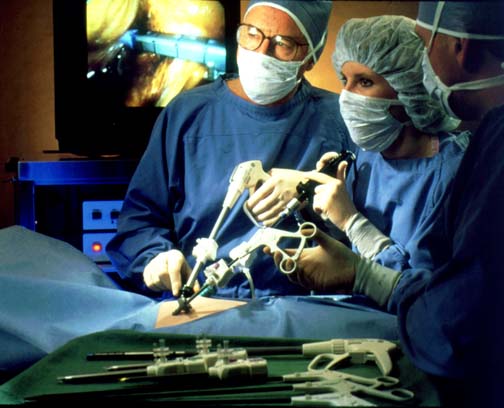
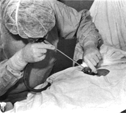
need to make a large incision. Instead, the surgeon operates through 3 or
4 tiny openings about the size of buttonholes, while viewing the patient's
internal organs on a TV monitor.
This is really the most important difference between laparoscopy and traditional
surgery. There is no large incision to heal, so patients  have less pain and recover sooner.
Laparoscopy is literally setting new standards for patient care because
it allows surgeons to perform many operations without the trauma and pain
of a large incision. Thanks to both the skill of the surgeon and advances
in technology, laparoscopic techniques are being applied to a growing number
of procedures and someday will likely replace open surgical techniques in
many areas.
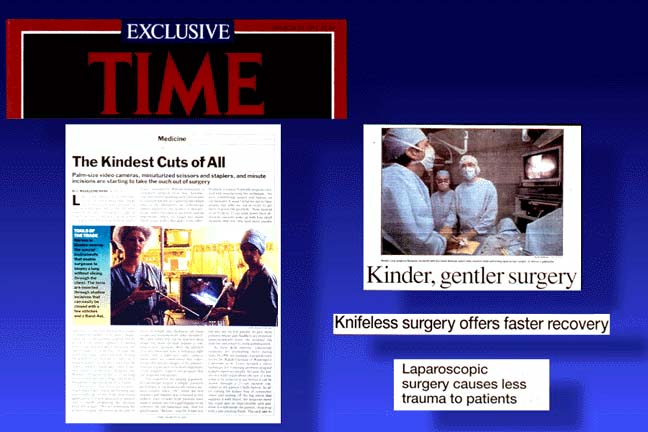
Because there has been tremendous progress in a relatively short period
of time, and because the technique has received so much attention in the
popular press, most people are suprised to learn that laparoscopy itself
is not new.

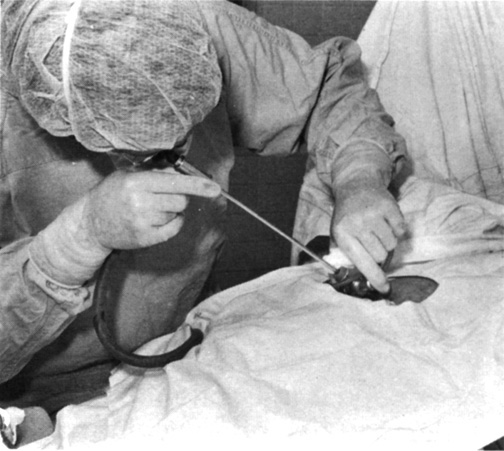
In fact, it actually dates back to as early as 400 B.C. - to the time of
Hippocrates, the father of medicine.
Modern surgeons began perfecting its use in the early part of this century,
but laparoscopy remained pretty much a diagnostic procedure until the 1970's
when gynecologic surgeons began using laparoscopic techniques to perform
female sterilizations, known as tubal ligations.
The real advantage in laparoscopy did not come until 1989, when doctors
in Atlanta and Nashville began applying laparoscopic techniques to gallbladder
operations.
Because so many people must undergo gallbladder surgery and face weeks of
painful recovery, the doctors were looking for a  less-invasive method to remove
the diseased organ.
What they developed has become one of the most widely recognized surgical
innovations since the introduction of anesthesia.
Rather than a 6- to 9- inch incision, the laparoscopic technique utilized
only 4 tiny openings - all less than 1/2 inch in diameter
Instead of a 5- to 8-day hospital stay and 4 to 6 weeks of painful recovery
at home, most patients now leave the hospital in a day or two and return
to normal activites within a week.
When these benefits became widely recognized among patients and surgeons,
the demand for the minimally invasive procedure exploded.
Today more than 95% of the 600,000 gallbladder operations performed each
year in the U.S. are done laparoscopically.
You may be wondering if this approach, known as laparoscopic cholecystectomy,
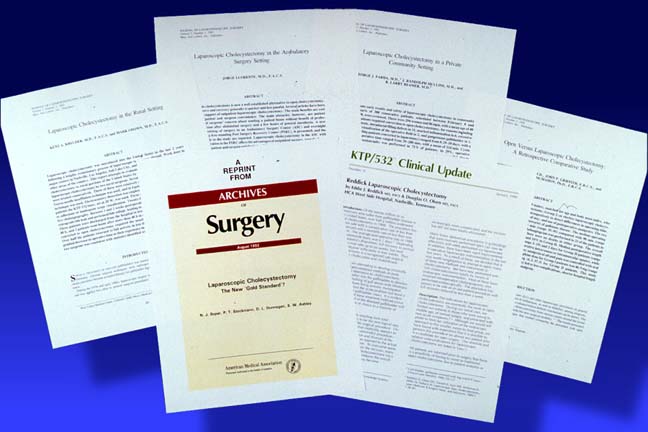
is as safe as the open procedure. Numerous medical studies have shown that
the answer is YES.
The National Institutes of Health (NIH) had a panel of experts review all
the available medical evidence. They compared the results of more than 100,000
laparoscopic cases with more than 200,000 cases of traditional gallbladder
removal, and they found laparoscopic  cholecystectomy to be as safe and effective
as traditional open surgery.
The panel also found that the complication rate for laparoscopic cholecystectomy
was actually lower than the complication rate for the open procedure.
The NIH concluded that the laparoscopic approach is the "procedure
of choice."
Today, in addition to gallbladder surgery, surgeons are applying these techniques
to a wide variety of gynecologic, general, thoracic and urologic procedures.
home | surgeons
| nurses | hospital
administrators | reference room |
did you know? | about
USSC

Copyright © 1997 United States Surgical Corporation. All Rights Reserved.
Contact webteam