Notes to Consolidated Financial Statements
Note A - Summary of Significant Accounting Policies
United States Surgical Corporation and Subsidiaries (the Company) is primarily engaged in developing, manufacturing and marketing a proprietary line of technologically advanced surgical wound management products to hospitals throughout the world. The Company currently operates domestically and internationally through subsidiaries, divisions, and distributors.
The preparation of financial statements in conformity with generally accepted accounting principles requires management to make estimates and assumptions that affect the reported amounts of assets and liabilities and disclosure of contingent assets and liabilities at the date of the financial statements and the reported amounts of revenues and expenses during the reporting period. Actual results could differ from those estimates.
Consolidation. The consolidated financial statements include the accounts and transactions of United States Surgical Corporation and Subsidiaries, excluding intercompany accounts and transactions. Certain subsidiaries (including branches), primarily operating outside the United States, are included in the consolidated financial statements on a fiscal-year basis ending November 30.
Property, Plant, and Equipment. Depreciation and amortization is provided using the straight-line method over the following estimated useful lives:
Years
Buildings 40
Molds and dies 2 to 7
Machinery and equipment 3 to 10
Leasehold improvements 3 to 30
The Company capitalizes interest incurred on funds used to construct property, plant, and equipment. Interest capitalized during 1995, 1994 and 1993 was immaterial.
Inventories. Inventories are stated at the lower of cost (first-in, first-out method) or market.
Other Assets. The Company capitalizes and includes in Other assets the costs of acquiring patents on its products, the costs of computer software developed and used in its information processing systems, goodwill arising from the excess of cost over the fair value of net assets of purchased businesses and deferred start-up costs incurred prior to 1991 relating to the Company's entrance in 1991 into the suture portion of the wound management market. Costs of Other assets are amortized on the straight-line basis over the following estimated useful lives:
Years
Patents 10
Computer software costs 3
Deferred start-up costs 5
Goodwill 10 to 40
Revenue Recognition. Revenues from sales are recognized when products are sold directly by the Company to ultimate consumers, primarily hospitals, or to authorized distributors.
Foreign Currency Translation. For translation of the financial statements of its international operations the Company has determined that the local currencies of its international subsidiaries are the functional currencies. Assets and liabilities of foreign operations are translated at year end exchange rates, and income statement accounts are translated at average exchange rates for the year. The resulting translation adjustments are made directly to the Accumulated Translation Adjustments component of Stockholders' Equity. Foreign currency transactions are recorded at the exchange rate prevailing at the transaction date.
Net Income (Loss) per Common Share. Net income (loss) per common share is based on the weighted average number of common shares and, where material, common share equivalents (stock options) outstanding. Common share equivalents are not included in the computation of net income (loss) per share in 1995, 1994 and 1993 since the effect of their inclusion would be antidilutive.
Note B - Restructuring Charges
The Company recorded restructuring charges of approximately $7 million in 1995. These restructuring charges related primarily to lease termination and employee severance costs associated with the relocation of one of the Company's largest international subsidiaries as part of the plan to centralize the distribution of the Company's products to its European customers. In addition, severance payments and other charges were incurred in 1995 in relation to the restructuring of the Company's manufacturing plants. The majority of the cash outlays relative to these restructuring charges were made in the third and fourth quarters of 1995 with the remainder of the cash outlays to be made in the subsequent two quarters. The 1995 restructuring charges were basically offset by the reversal of restructuring cost estimates in excess of ultimate costs which were originally recognized in the Company's 1993 consolidated statements of operations.
Accrued liabilities at December 31, 1995 and 1994 included $9 million and $18 million, respectively, which related primarily to severance costs and accrued lease obligations associated with the Company's 1995 and 1993 restructuring charges. The Company has either terminated or bought out the leases of the leased properties and paid substantially all employee severance costs which were part of the 1993 restructuring charges. The majority of the 1995 accrued termination charges and other restructuring charges will be liquidated by the end of the second quarter 1996.
Adoption of FAS 123. The Company will adopt the provisions of Statement of Financial Accounting Standards No. 123 "Accounting for Stock-Based Compensation" (FAS 123) in the first quarter of 1996. The Company, as provided for by FAS 123, will continue to apply Accounting Principles Board Opinion No. 25, "Accounting for Stock Issued to Employees" for employee stock compensation measurement. The anticipated effect of adopting this new standard is not expected to have a material effect on the Company's consolidated financial position or results of operations.
MANAGEMENT REPORT ON RESPONSIBILITY FOR FINANCIAL REPORTING
The management of United States Surgical Corporation and its subsidiaries (the "Company") has the responsibility for preparing the accompanying consolidated financial statements and related notes. The consolidated financial statements were prepared in accordance with generally accepted accounting principles and necessarily include amounts based upon judgments and estimates by management. Management also prepared the other information in the annual report and is responsible for its accuracy and consistency with the consolidated financial statements.
Management of the Company has established and maintains a system of internal controls that provide reasonable assurance that the accounting records may be relied upon for the preparation of the consolidated financial statements. Management continually monitors the system of internal controls for compliance. Also, the Company maintains an internal auditing function that independently assesses the effectiveness of the internal controls and recommends possible improvements thereto. The Company's consolidated financial statements have been audited by Deloitte & Touche LLP, independent auditors. Management has made available to Deloitte & Touche LLP all the Company's financial records and related data. In addition, in order to express an opinion on the Company's consolidated financial statements, Deloitte & Touche LLP considered the internal accounting control structure in order to determine the extent of their auditing procedures for the purpose of expressing such opinion but not to provide assurance on the internal control structure. Management believes that the Company's system of internal controls is adequate to accomplish the objectives discussed herein.
The Board of Directors monitors the internal control system through its Audit Committee which consists solely of outside directors. The Audit Committee meets periodically with the independent auditors, internal auditors and senior financial management to determine that they are properly discharging their responsibilities.
|
|
INDEPENDENT AUDITORS' REPORT
Board of Directors and Stockholders
UNITED STATES SURGICAL CORPORATION
We have audited the accompanying consolidated balance sheets of United States Surgical Corporation and subsidiaries as of December 31, 1995 and 1994 and the related consolidated statements of operations, changes in stockholders' equity and cash flows for each of the three years in the period ended December 31, 1995. These financial statements are the responsibility of the Company's management. Our responsibility is to express an opinion on the consolidated financial statements based on our audits.
We conducted our audits in accordance with generally accepted auditing standards. Those standards require that we plan and perform the audit to obtain reasonable assurance about whether the consolidated financial statements are free of material misstatement. An audit includes examining, on a test basis, evidence supporting the amounts and disclosures in the consolidated financial statements. An audit also includes assessing the accounting principles used and significant estimates made by management, as well as evaluating the overall consolidated financial statement presentation. We believe that our audits provide a reasonable basis for our opinion.
In our opinion, such consolidated financial statements present fairly, in all material respects, the financial position of United States Surgical Corporation and subsidiaries at December 31, 1995 and 1994, and the consolidated results of their operations and their cash flows for each of the three years in the period ended December 31, 1995 in conformity with generally accepted accounting principles.
Deloitte & Touche LLP
Stamford, Connecticut
January 22, 1996
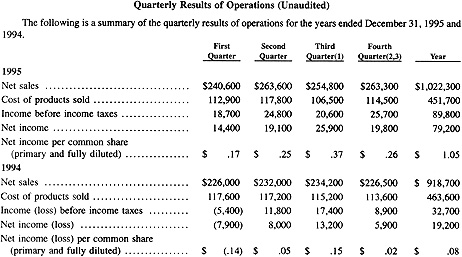
(1) In the third quarter of 1995, the Company reached an agreement with respect to the settlement of all issues raised by the Internal Revenue Service in the examination of the Company's income tax returns for the years 1984 through 1990. As a result of the agreement, the Company recognized a net credit to the tax provision of $10 million ($ .18 per common share) in the third quarter of 1995.
(2) In the fourth quarter of 1994, the Company reached an agreement to purchase certain assets of its former Japanese distributor and accrued for the reacquisition of inventory from this distributor and reduced Net sales by $17 million and Net income by $8 million ($.14 per common share).
(3) Cost of products sold in the fourth quarter of 1995 includes $13 million of inventory and fixed asset reserves ($16 million in the corresponding period in 1994) resulting from the continued introduction of new products and the consequent obsolescence of production tooling and inventories.
Common Stock Prices and Dividends
The Company's Common Stock is traded on the New York Stock Exchange under the symbol USS. The following table sets forth for the periods indicated the high and low of the daily sales prices, which represent actual transactions, as reported by the New York Stock Exchange. In addition, the table sets forth the amounts of quarterly cash dividends per share that were declared and paid by the Company.
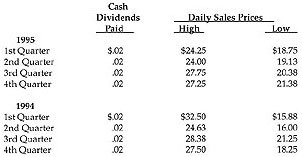
At December 31, 1995, the number of record holders of the Company's Common Stock was 10,381. See discussion below in Management's Discussion and Analysis of Financial Condition and Results of Operations as to restrictions imposed by a credit agreement on registrant's level of dividend payments.
Description of the Company's Business
United States Surgical Corporation (the Company) is a Delaware corporation primarily engaged in developing, manufacturing and marketing a proprietary line of technologically advanced surgical wound management products to hospitals throughout the world. The Company currently operates domestically and internationally through subsidiaries, divisions and distributors. Except where the context otherwise requires, the term Company includes the Company's divisions and subsidiaries.
The market that the Company services continues to be adversely affected by cost consciousness on the part of health care providers and payors and to experience slower growth rates created by efforts to reduce costs and by uncertainties connected with health care reform. The Company believes, however, that in any scenario that results from evolution of the domestic health care system, its products offer a significant opportunity for reducing costs for the total health care system while providing considerable advantages for the patient. The Company has also been impacted negatively by aggressive pricing by competition.
To respond to these business conditions, the Company has expanded its marketing efforts to meet the needs of hospital management through cost effective pricing programs, by assisting hospitals in implementing more efficient surgical practices, and by demonstrating the favorable economics associated with the use of the Company's products. The Company continually expands its product and technology base through investment in internal research and development and through the acquisition of new products and technologies that provide better patient care and an effective means of reducing hospital costs. By offering technologically advanced products which can replace more expensive, more invasive procedures and by assisting hospital management in implementing more efficient surgical practices, the Company seeks to establish and maintain a strong competitive position.
The Company is a leading multinational developer, manufacturer and marketer of innovative surgical wound closure products. In this category, principal products consist of a series of surgical stapling instruments (both disposable and reusable), disposable surgical clip appliers and disposable loading units (DLUs) for use with stapling instruments. The instruments are an alternative to manual suturing techniques utilizing needle/suture combinations and enable surgeons to reduce blood loss, tissue trauma and operating time while joining internal tissue, reconstructing or sealing off organs, removing diseased tissue, occluding blood vessels and closing skin, either with titanium, stainless steel, or proprietary absorbable copolymer staples or with titanium, stainless steel, or proprietary absorbable copolymer clips. Surgical stapling also makes possible several surgical procedures which cannot be achieved with surgical needles and suturing materials. The disposable instruments and DLUs are expended after a single use or, in the case of reloadable disposable instruments, after a single surgical procedure.
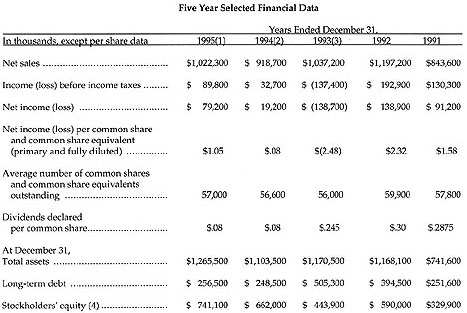
(1) In the third quarter of 1995, the Company reached an agreement with respect to the settlement of all issues raised by the Internal Revenue Service in the examination of the Company's income tax returns for the years 1984 through 1990. As a result of the agreement, the Company recognized a net credit to the tax provision of $10 million ($ .18 per common share) in the third quarter of 1995.
(2) In the fourth quarter of 1994 the Company signed a letter of intent to purchase certain assets of its independent distributor in Japan, which included inventory of the Company's products purchased by the independent distributor but not yet sold to third parties at December 31, 1994. Sales and Net income were reduced by $17 million and $8 million ($.14 per common share), respectively, in anticipation of the pending reacquisition of these products and valuing these products at the Company's cost.
(3) Income (loss) before income taxes and net income (loss) for 1993 include restructuring charges of $137.6 million and $129.6 million ($2.31 per share), respectively.
(4) Included in Stockholders' equity in 1995 and 1994 is $191.5 million of convertible preferred stock which has a liquidation value of $200.0 million.