


Paul Goodwin was back to work just days after laparoscopic hernia surgery.
An innovative new technique.
Approximately 600,000 hernia repair operations are performed annually in
the United States. Traditional open hernia repair surgery means a large
incision, 3 to 5 weeks of painful recuperation and an increased possibility
of infection.
Now, a laparoscopic technique makes it possible to perform this procedure
in a minimally invasive manner. The patient goes home with only 3 or 4 tiny
incisions, experiences minimal discomfort and, in many cases can return
to normal activity in as little as two days.
What is a hernia?
A hernia occurs when the inside layers of the abdominal wall weaken and
then bulge or tear. In the same way an inner tube pushes through a damaged
tire, the inner lining of the abdomen pushes through the weakened area to
form a balloon-like sac. This in turn, can cause a loop of intestine or
abdominal tissue to slip into the sac, causing severe pain and other potentially
serious health problems.
How do you get a hernia?
Hernias usually occur because of a natural weakness in the abdominal wall
or from excessive strain on the abdominal wall. In males, a natural weakness
is created prior to birth when the testis (testicle) and spermatic cord
descend through the inguinal canal from the abdominal cavity into the scrotum.
In females, a ligament makes the same descent through the canal.
Is there more than one kind of hernia?
Although any part of the abdominal wall can rupture, approximately 80% of
all hernias are located near the groin. When a hernia near the groin occurs
because of a natural weakness, it is called an indirect inguinal hernia.
When a hernia near the groin is caused by excessive strain, it is called
a direct inguinal hernia. Hernias may also be found below the groin (femoral),
through the navel (umbilical), and along a previous incision (incisional).
Can anyone get a hernia?
A hernia can happen to anyone at any age. In children, an excessive natural
weakness can lead to a hernia. In adults, a natural weakness or strain from
heavy lifting, substantial weight gain, persistent coughing or difficulty
with bowel movements or urination can cause the abdominal wall to tear.
How is traditional hernia repair performed?
A 3- to 5-inch incision is made through several layers of skin, fatty tissue
and muscle to reveal the hernial sac. The incision is made on an angle just
above the line where the abdomen meets the thigh.
The most important part of the surgical repair involves removal of the hernial
sac and closure of the opening in the inguinal canal. This closure is accomplished
by sewing the edges of the remaining tissue together after the hernial sac
is removed or by attaching a mesh patch to the outside of the abdominal
wall just beneath the layer of muscle.
How is laparoscopic hernia repair performed?
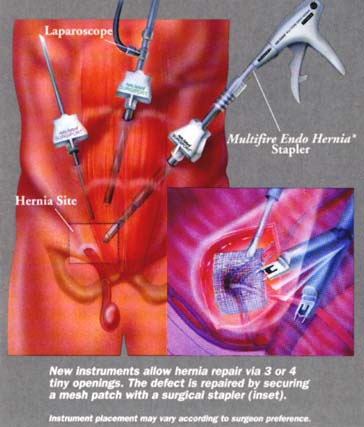
Laparoscopic hernia repair usually takes place under general anesthesia,
so the patient is asleep throughout the procedure. Using a trocar (a narrow
tube-like instrument), the surgeon gains access to the abdomen through the
navel. 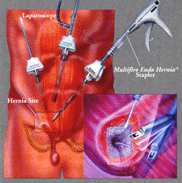 A laparoscope (a tiny telescope) connected to a camera is inserted
through the trocar, giving the surgeon a magnified view of the patient's
internal organs on a video monitor.
Two or three additional trocars are inserted to accommodate special instrumentation.
The surgeon pulls the hernial sac back into the abdominal cavity and opens
it to expose the defect in the abdominal wall. The defect is covered with
a mesh patch that is anchored securely to the abdominal wall with an instrument
called the MULTIFIRE ENDO HERNIA* stapler.
Following the repair, the small incisions are closed with a stitch or two
or surgical tape. Within a few months, the incisions are barely visible.
What are the advantages of laparoscopic hernia repair?
Laparoscopic hernia repair requires only 3 or 4 tiny openings, each 1/4
to 1/2 inch in diameter, instead of the traditional 3- to 5-inch incision.
As a result, patients experience much less postoperative pain, heal faster,
and many are able to resume normal activities in as little as two days compared
to 3 to 5 weeks.
In addition, with laparoscopic hernia repair, the mesh patch used to cover
the abdominal defect is placed on the inside of the abdominal wall instead
of the outside. This method works with the natural outward pressure of the
abdomen to secure the repair and promote healing.
How soon will I go home?
Both traditional and laparoscopic hernia repair are usually performed on
an outpatient basis. Patients are generally permitted to return home within
4 to 6 hours following the procedure.
Should I be concerned that this is a new procedure?
Laparoscopy has been used in gynecologic surgery for nearly three decades,
and today, more than 90% of all gallbladder surgery is performed laparoscopically.
More recently, general and thoracic surgeons have applied the laparoscopic
technique to a broad range of surgical procedures including appendectomy,
hysterectomy and lung and bowel surgery.
It is important to remember that before undergoing any type of surgery,
whether laparoscopic or traditional, you should ask your surgeon about his
or her training and experience.
Am I a candidate for laparoscopic hernia repair?
If you have an inguinal or femoral hernia, you may be a candidate for laparoscopic
hernia repair. Although there are many advantages to laparoscopy, the procedure
may not be appropriate for some patients who have some pre-existing medical
conditions. A thorough evaluation by a qualified surgeon can determine if
laparoscopic hernia repair is an appropriate procedure for you.

Contact webteam
 A laparoscope (a tiny telescope) connected to a camera is inserted
through the trocar, giving the surgeon a magnified view of the patient's
internal organs on a video monitor.