

Questions & Answers About the Laparoscopic Treatment of Urinary Stress
Incontinence
Urinary incontinence -- the involuntary loss of urine -- dramatically affects
the lives of 17 million American men and women of all ages. Because of the
stigma associated with the condition, many are too embarrassed to talk about
their problem. As a result, less than half seek treatment even though approximately
80% can be cured. When left untreated, incontinence often leads to social
isolation, depression and low self-esteem.
More than half the people with incontinence suffer from urinary stress incontinence.
In the past, these people sought relief by dramatically altering their lifestyle
or by undergoing an effective, but debilitating, surgical procedure. Because
traditional surgery involves a large incision, a 3- to 6-day hospital stay
and up to 6 weeks of recovery at home, it was typically limited to those
patients who do not respond well to other forms of treatment.
Now, a laparoscopic technique makes it possible to perform the same operation,
bladder neck suspension, without the long hospital stay or difficult recovery.
Most patients can go home in as little as a day with only 3 to 5 tiny marks.
In most cases, they can resume normal activities within a week.
What is urinary incontinence?
Loss of bladder control is not a disease, but rather a sign that a problem
exists. There are 4 basic forms of urinary incontinence: stress, urge, overflow
and reflex. They are caused by a number of possible conditions or disorders
that affect the urinary system.
 What
is urinary stress incontinence?
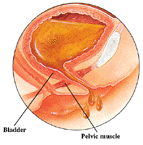
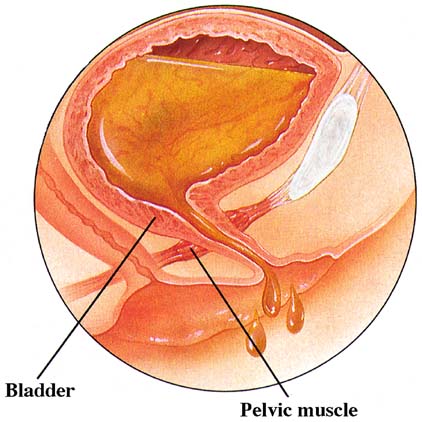
Urinary stress incontinence occurs when the urethral sphincter or pelvic
muscle cannot adequately support the bladder. This allows the bladder to
slip down into the pelvic cavity and place pressure on the urethra, the
duct that carries urine from the bladder to outside the body. As a result,
body movements, such as exercising, coughing or sneezing, can place additional
pressure on the bladder causing it to leak. Although it can affect anyone,
it is a common condition among women who have gone through childbirth or
menopause.
How is urinary stress incontinence treated?
Once a diagnosis has been made, stress incontinence is usually treated with
lifestyle adjustments, exercises and medication. While these forms of treatment
can be effective in mild cases of stress incontinence, patients with more
severe cases sometimes require surgery.
In these cases, a surgical procedure, known as bladder neck suspension,
alleviates the pressure placed on the urethra by elevating the neck of the
bladder. Although effective, the traditional "open" procedure
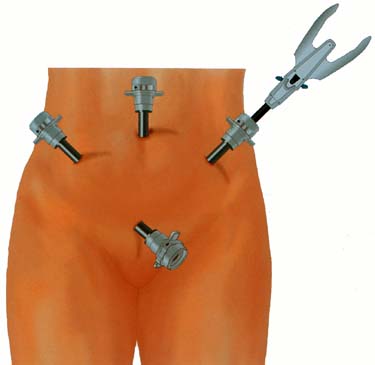
requires a large incision and a long, painful recovery. 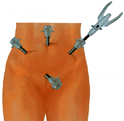 Using laparoscopic techniques, surgeons
can now perform the same procedure through 3 to 5 tiny openings.
How is laparoscopic bladder neck suspension performed?
In the laparoscopic procedure, the surgeon uses a trocar (a narrow, tube-like
instrument) to gain access to the abdomen. A laparoscope (a tiny telescope
connected to a video camera)  is inserted through the trocar, giving the surgeon a magnified view
of the patient's internal organs on a television monitor. Up to 4 additional
trocars are used for special instrumentation.
After lifting the tissue adjacent to the bladder into position, the surgeon
attaches it to the abdominal wall using the ENDO STITCH* suturing device.
Following the procedure, the small incisions are closed with a stitch or
two or with surgical tape. Within a few months, the incisions are barely
visible.
Is bladder neck suspension effective?
Since it's introduction in 1958, "open" bladder neck suspension
has become the "gold standard" in surgical treatment for urinary
stress incontinence. Studies have shown that approximately 75-90% of all
patients remain continent or see a marked improvement. Many surgeons expect
similar results with the laparoscopic approach because the actual bladder
suspension is performed in the same way.
What are the advantages of laparoscopic bladder suspension?
By operating through 3 to 5 tiny openings instead of the traditional 5-inch
incision, most laparoscopic patients experience less pain, less scarring,
a shorter hospital stay and a quicker recovery than patients undergoing
the open procedure. In addition, most patients do not require long-term
catheterization after surgery. With the traditional procedure, patients
are often catherized for an average of 8 days.
How long will I be in the hospital?
Most patients leave the hospital 1 to 2 days after laparoscopic bladder
neck suspension. In comparison, most patients who undergo the traditional
procedure spend 3 to 6 days in the hospital.
When can I go back to work?
Most patients can return to work and other normal activities in as little
as a week following the laparoscopic procedure. This compares with 4 to
6 weeks for patients who have open bladder neck surgery.
Should I be concerned that laparoscopic bladder neck suspension is new?
Minimally invasive surgical techniques have been used in gynecologic surgery
for nearly 3 decades, and today, more than 90% of all gallbladder surgery
is performed using these techniques. More recently, surgeons have applied
minimally invasive techniques to a broad range of procedures including hernia
repair, appendectomy, hysterectomy, heartburn surgery and lung and bowel
surgery.
Before undergoing any type of surgery, whether minimally invasive or open,
be sure to ask your surgeon about his or her training and experience.
Am I a candidate for laparoscopic bladder neck suspension?
Although there are many benefits associated with laparoscopy, it may not
be appropriate for some patients, including those who have had previous
abdominal surgery or who have some pre-existing medical conditions. A thorough
medical evaluation by your primary care physician, in consultation with
a surgeon trained in laparoscopy, can determine if laparoscopic bladder
suspension is an appropriate procedure for you.

Contact webteam
 What
is urinary stress incontinence?
 Using laparoscopic techniques, surgeons
can now perform the same procedure through 3 to 5 tiny openings.
 is inserted through the trocar, giving the surgeon a magnified view
of the patient's internal organs on a television monitor. Up to 4 additional
trocars are used for special instrumentation.