Mary Davidson's busy life wasn't interrupted by her hysterectomy
An innovative new technique
Hysterectomy (surgical removal of the uterus) is one of the most commonly performed procedures in the United States. Abdominal hysterectomy typically requires women to spend four to six days in the hospital and four to six weeks recuperating at home.
Now, a technique called laparoscopy makes it possible to perform this procedure in a minimally invasive manner, allowing patients to go home one or two days after surgery and to resume full activity within a week or two.
Hysterectomy past...present...
Until recently, about 75% of all hysterectomies were performed through an incision in the abdomen. In the remaining cases, the uterus was removed vaginally.
Both procedures have drawbacks: the abdominal approach requires a four-to-six-inch incision and results in considerable postoperative pain, a lengthy recuperation and a visible scar. Vaginal hysterectomy is not possible if the patient's ovaries must be removed, if the patient has had previous pelvic surgery or if the surgeon must treat related disorders near the uterus.
Now, for many women facing an abdominal hysterectomy, there's a dramatic alternative: laparoscopically assisted vaginal hysterectomy (LAVH).
and future
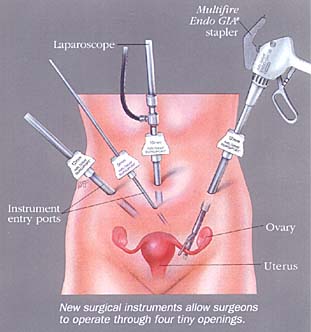
LAVH takes place under general anesthesia, so the patient is unconscious throughout the procedure. Using a trocar (a narrow tube-like instrument), the surgeon gains access to the abdomen through the navel. A laparoscope (a tiny telescope) connected to a camera is inserted through the trocar, allowing the surgeon to view a magnified image of the patient's internal organs on a video monitor. This enables the surgeon to perform the hysterectomy as well as to diagnose and treat related conditions at the same time.
Two or three additional trocars are inserted to accommodate special instrumentation. An instrument called the MULTIFIRE ENDO GIA* stapler is used to detach the uterus and seal its supporting vessels with triple rows of tiny staples. The uterus is then removed through the vagina and the minute incisions are closed with sutures or surgical tape. Within a few months, the incisions are barely visible.
The laparoscopic revolution
Laparoscopy was pioneered by gynecologists in the early 1960s, and has been widely used in a range of procedures, including tubal ligation, the removal of ovaries and fibroids (benign fibrous tumors of the uterus), and the treatment of tubal pregnancies.
In 1989, United States Surgical Corporation (USSC) developed an instrument for laparoscopic gallbladder removal that significantly reduced the pain, scarring, hospital stay and recovery time associated with that procedure. USSC has introduced instruments for laparoscopic appendectomy, hernia repair, lung and bowel surgery, and a broad range of gynecologic procedures, including hysterectomy.
If you're concerned that laparoscopic hysterectomy is relatively new, remember that gynecologic surgeons have been using laparoscopy for the past three decades. More than 95% of all gallbladder surgery is now performed using this technique. Similarly, LAVH is rapidly gaining acceptance among gynecologic surgeons and their patients.
LAVH may be for you.
Each year, some 650,000 women in the United States undergo hysterectomy. Surgeons believe that many patients who need an abdominal hysterectomy may be treated with the laparoscopic technique. A thorough evaluation by your gynecologist can determine if LAVH is an appropriate procedure for you.
Compare:
Laparoscopic Hysterectomy
Abdominal Hysterectomy
Vaginal Hysterectomy
Hospital Stay
1-2 days 4-6 days 3-4 days
Return to Work
1-2 weeks 4-6 weeks 3-4 weeks
Cosmetic Results
3-4 tiny marks 4-6 inch scar No visible scar
Recuperative Pain
Minimal Significant Moderate
Ability to Deal with Other Pelvic Pathologies
Excellent Excellent Poor
Ability to Remove Overies
Easy Easy Difficult or impossible