

Questions and Answers on Laparoscopic Treatment of Heartburn
Heartburn. More than 44% of all adults in the United States (61 million
people) experience this uncomfortable, burning sensation at least once a
month. For most, it's an occasional occurrence that is easily relieved with
an over-the-counter antacid. But for others, heartburn is a daily struggle
that has changed the way they live their lives - from what they eat, to
how they sleep, to the type of clothes they can wear.
Severe cases of heartburn may be treated with extensive drug therapy or
surgically corrected. The traditional surgical procedure, known as Nissen
fundoplication, involves a large incision, a hospital stay of 6 to 10 days
and a recovery period of 6 to 8 weeks. As a result, surgery has typically
been limited to those patients with extreme or life-threatening conditions.
Now, a laparoscopic technique makes it possible to perform the same operation
in a minimally invasive manner. Most patients go home in 2 or 3 days with
only 5 tiny marks and, in most cases, can return to work and other normal
activities within a week.
What is heartburn?
Although "heartburn" is often used to describe a variety of digestive
problems, in medical terms, it is actually a symptom of gastroesophageal
reflux disease, a condition in which stomach acids reflux, or surge upward
from the stomach into the esophagus. Described as a harsh, burning sensation
in the upper abdomen, the feeling can radiate through the chest, and into
the throat and neck. Other symptoms may also include regurgitation, difficulty
swallowing and chronic coughing or wheezing.
Why does heartburn occur?
At the bottom of the esophagus there is a high-pressure zone called the
lower esophageal sphincter (LES). The LES acts like a valve to the stomach,
remaining closed until swallowing forces the valve open. Normally, the LES closes immediately after swallowing to prevent reflux. When the LES relaxes, it fails to provide adequate closure and allows stomach acids to reflux back into the esophagus, irritating the lining and causing
a burning sensation.
What contributes to heartburn?
Some people are born with a naturally weak sphincter. But for others, fatty
and spicy foods, certain types of medication, tight clothing, smoking, drinking
alcohol, vigorous exercise or changes in body position, (bending over or
lying down) may cause the LES to relax, causing reflux. A hiatal hernia also is present in many patients who suffer from heartburn, although doctors agree it alone cannot cause gastroesophageal reflux.
How is heartburn treated?
A reflux problem has traditionally been treated in 3 steps: lifestyle changes,
drug therapy and surgery.
In many cases changing diet and taking over-the-counter antacids can reduce
the frequency and severity of attacks. Losing weight, reducing smoking and
alcohol consumption and altering eating and sleeping patterns, also can
help. But if symptoms persist after these lifestyle changes, long-term drug
therapy may be required.
In severe cases, drugs like TagametÆ or ZantacÆ may be prescribed.
While antacids neutralize stomach acids, these drugs actually reduce the
amount of acid produced. More aggressive treatments include ReglanÆ,
a drug that strengthens the LES and causes the stomach to empty faster,
and OmeprazoleÆ, a drug that relieves symptoms and heals the esophagus
faster than the other medications.
Until recently, patients who did not respond well to lifestyle changes or
drug therapy, had to either live with their condition or undergo a surgical
procedure known as Nissen fundoplication. However, because the traditional
"open" procedure requires a large incision and a long, painful
recovery, it is generally considered a "last resort" treatment
for extreme or life-threatening cases. Now, using laparoscopic techniques,
surgeons can operate without a major incision.
How is laparoscopic Nissen fundoplication performed?
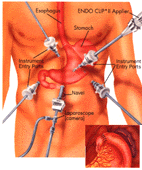 Nissen
fundoplication involves constructing a new "valve" between the
esophagus and the stomach by wrapping the upper portion of the stomach around
the lowest point of the esophagus, much the way a bun fits around a hot
dog.
In the laparoscopic procedure, surgeons use a trocar (a narrow tube-like
instrument) to gain access to the abdomen. A laparoscope (a tiny telescope
connected to a video camera) is inserted through the trocar, giving the
surgeon a magnified view of the patient's internal organs on a television
monitor.
Four additional trocars are inserted to accommodate special instrumentation.
The surgeon pulls the liver back to expose the junction between the stomach
and the esophagus, and the vessels surrounding the stomach are sealed using
an instrument such as the ENDO CLIP* II applier. After the vessels are cut,
the upper portion of the stomach, the "bun", is then positioned
around the end of the esophagus, the "hot dog", and secured in
place with the ENDO STITCH* suturing device.
Following the procedure, the small incisions are closed with a stitch or
two or with surgical tape. Within a few months, the incisions are barely
visible.
Is Nissen fundoplication surgery effective?
Open Nissen fundoplication was introduced by Dr. Rudolph Nissen in 1951.
Studies have shown that more than 90% of patients who undergo the procedure
are symptom-free after 10 years. Many surgeons familiar with both approaches
believe that the long-term results will be just a good with the laparoscopic
approach because the actual fundoplication is performed in the exact same
manner.
What are the advantages of the laparoscopic method?
By operating through 5 tiny openings instead of the traditional 6- to 10-inch
long incision, most laparoscopic patients experience less pain, less scarring,
a shorter hospital stay and a quicker recovery than patients undergoing
the open procedure.
How long will I be in the hospital?
In most cases, patients leave the hospital 2 or 3 days after laparoscopic
Nissen fundoplication. This compares with a 6- to 10-day stay following
the traditional procedure.
When can I go back to work?
Most patients can return to normal activities within a week following the
laparoscopic procedure. Patients undergoing the traditional procedure usually
resume normal activities in 6 to 8 weeks.
Should I be concerned that the laparoscopic technique is new?
Laparoscopy has been use in gynecologic surgery for nearly 3 decades, and
today, more than 90% of all gallbladder surgery is performed laparoscopically.
More recently, general and thoracic surgeons have applied the laparoscopic
technique to a broad range of surgical procedures including appendectomy,
hysterectomy, lung, bowel and hernia surgery.
However, it is important to remember to ask your surgeon before undergoing
any type of surgery--whether laparoscopic or traditional--about his or her
training or experience.
Am I a candidate for laparoscopic Nissen fundoplication?
Although there are many advantages to laparoscopy, the procedure may not
be appropriate for some patients, including those who have had previous
abdominal surgery or who have some pre-existing medical conditions. A thorough
medical evaluation by your personal physician, in consultation with a general
surgeon trained in laparoscopy, can determine if laparoscopic Nissen fundoplication
is an appropriate procedure for you.

Contact webteam
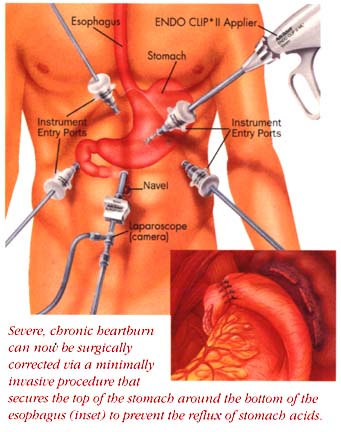 Nissen
fundoplication involves constructing a new "valve" between the
esophagus and the stomach by wrapping the upper portion of the stomach around
the lowest point of the esophagus, much the way a bun fits around a hot
dog.