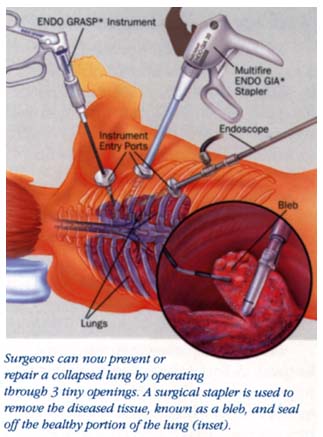
Video Assisted Lung and Chest Surgery (VATS)
Each year, more than a million thoracic (chest) surgical procedures are
performed in the United States for heart and lung disease, muscle and nerve
disorders, ulcers and other serious illnesses.
Although surgery may be the best, or only way to treat the disease, patients
can sometimes face a long and difficult recovery because traditional "open"
thoracic surgery is highly invasive. In most cases, surgeons must make a
long incision through chest muscles and then cut or spread the patient's
ribs to reach the diseased area. As a result, patients may spend up to a
week in the hospital and up to 4 to 6 weeks of recovery at home.
Now, a surgical technique known as video assisted thoracic surgery (VATS)
is enabling surgeons to perform many common thoracic procedures in a minimally
invasive manner. Depending on the type of procedure, most patients do not
need intensive care, can leave the hospital in 1 to 3 days and, in many
cases, are back to normal activities within a week.
What is video assisted thoracic surgery?
In most VATS procedures, surgeons operate through 2 to 4 tiny openings between
the ribs while viewing the patient's internal organs on a television monitor.
Each opening is less that one inch in diameter, whereas 6- to 10-inch incisions
are not uncommon in open thoracic surgery.
What diseases can be treated with VATS?
Because it can offer patients significant advantages over open surgery,
many surgeons believe that VATS will one day be used in the majority of
all thoracic procedures. While not every patient is a candidate for video
assisted thoracic surgery, VATS has been used to:
- Treat blebs on the lung (which can lead to a collapsed lung)
- Diagnose and treat fluid around the lung
- Diagnose and treat fluid around the heart
- Diagnose and treat mediastinal tumors (tumors in the area between the
lungs)
- Diagnose, or stage, lung cancer
- Treat lung cancer in patients who cannot tolerate open surgery
- Reduce lung volume in emphysema patients
Can other diseases be treated with VATS?
In addition to lung and heart procedure procedures, VATS also has been used
to treat:
- Myasthenia gravis (a disease resulting in weakened muscles
and fatigue)
- Nervous system disorders (excessive hand sweating abnormally cold, painful
upper hand and arm disorders)
- Severe ulcers
- Esophageal achalasia (a thickening of the muscle in the esophagus, which
causes difficulty in swallowing)
Am I a candidate for VATS?
Although there are many benefits associated with VATS, it may not be appropriate
for some patients, including those who have had previous thoracic surgery
or who have some pre-existing medical conditions. Only a through medical
evaluation by your personal physician, in consultation with a qualified
thoracic surgeon can determine if video assisted thoracic surgery is appropriate
for you.
How is VATS performed?
 It
is important to remember that neither VATS nor open thoracic surgery describes
a specific surgical procedure. Instead, they describe the techniques a surgeon
uses to gain access into the chest cavity or "thorax".
However, all VATS procedures generally start the same way. Patients are
placed under general anesthesia and are typically positioned on their sides.
Using a trocar (a narrow tube-like instrument), the surgeon gains access
into the chest cavity through a space between the ribs. An endoscope (a
tiny telescope connected to a video camera) is inserted through the trocar,
giving the surgeon a magnified view of the patient's internal organs on
a television monitor.
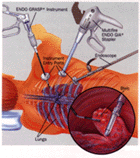
One of the most common VATS procedures is for preventing or repairing a
collapsed lung. Called a video assisted blebectomy, the procedure involves
removing diseased tissue, known as a bleb, which is like a blister on the
lung. If the bleb ruptures, it forms a hole, and the lung begins to deflate
or collapse.
To remove the bleb, the surgeon inserts three trocars: one for the endoscope
and two for special instrumentation. After locating the bleb, the surgeon
removes the diseased tissue and seals off the healthy portion of the lung
using the MULTIFIRE ENDO GIA* stapler.
Following the procedure, the small incisions are closed with surgical tape
or a stitch or two. In most cases, the incisions are barely visible after
a few months.
What are the advantages of VATS?
Because surgeons operate through 2 to 4 tiny openings instead of a long
incision, many VATS patients experience less pain, less scarring a shorter
hospital stay and, in many cases, a quicker return to work and other normal
activities than patients who undergo open surgery. In addition, because
it is not necessary to spread or cut the ribs, patients avoid some of the
"bone pain" associated with the open approach.
How long will I be in the hospital?
Most VATS patients are out of the hospital in 1 to 3 days, and less than
10% require intensive care. In comparison, most patients who undergo traditional
procedures spend 5 to 7 days in the hospital.
When can I go back to work?
Some patients return to work and other normal activities in as little as
a week after video assisted procedures. This compares with 4 to 6 weeks
for patients who have open surgery. However, you should consult your doctor
before returning to work or resuming other activities.
Should I be concerned that VATS is a new technique?
Minimally invasive surgical techniques have been used in gynecologic surgery
for nearly 3 decades, and today, more than 90% of all gallbladder surgery
is performed using these techniques. Most recently, surgeons have applied
minimally invasive techniques to a broad range of procedures including hernia
repair, appendectomy, hysterectomy, heartburn surgery and bowel surgery.
However, before undergoing any type of surgery, whether minimally invasive
or open, you should ask your surgeon about his or her training and experience.
What can I expect after surgery?
After surgery, it is important to follow your doctor's instructions. If
you are like most people who undergo a minimally invasive procedure, you
will probably feel better in just a few days. However, it is important to
remember that although you may feel great, your internal organs still need
time to heal. So if your doctor says take it easy for a week or two, take
it easy!
home | surgeons
| nurses | hospital
administrators | reference room |
did you know? | about
USSC
* Trademark of United States Surgical Corporation

Copyright © 1997 United States Surgical Corporation. All Rights Reserved.
Contact webteam