Part III
MARKET STAGES
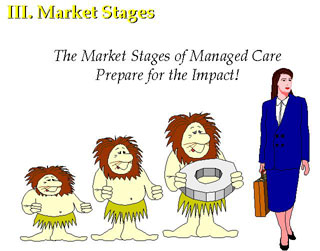
The Market Stages of Managed Care
Prepare for the Impact!
The evolution in healthcare is changing the way in which hospitals "do business". Hospitals must be able to read, analyze and plan how to respond to changes occurring in a specific market as a result of managed care.
It is essential that hospitals have a complete picture of their
in order to monitor their system on an on-going basis.
Managed Care: Stages of Market Evolution
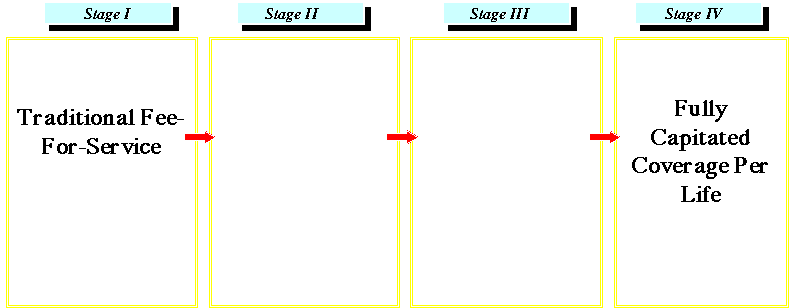
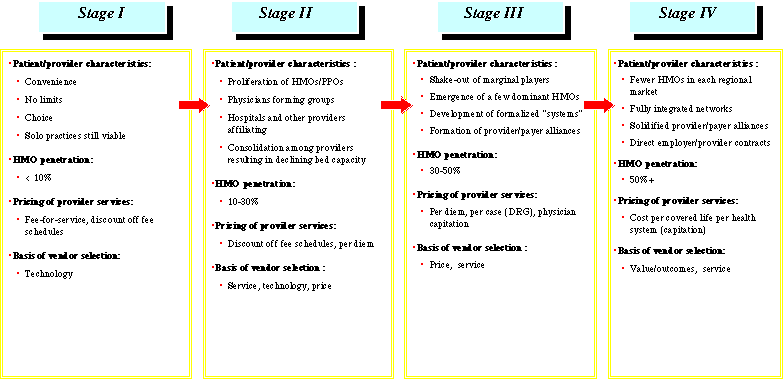
There are four stages in the evolution of the managed care market. The market moves from traditional fee-for-service to fully capitated.
By understanding the market stage of your local environment, your hospital is able to better understand the strategies and reimbursement policies of the managed care organizations in your area. For example, understanding that in a stage III market, providers are typically reimbursed on a per diem or per case basis can be very useful information for a hospital not yet in stage III. The hospital can anticipate and prepare for the next stage by developing a strategy to get its costs under control. Then the hospital can begin to develop a contract negotiations strategy for managed care reimbursement that will ensure the hospital's ability to remain profitable and strong into the future.
In addition, by knowing your local area's stage in the market, your hospital can determine how much leverage it may or may not have in contract negotiations. For example, if managed care penetration is at 50% or greater, the hospital knows it will most likely need to negotiate a capitated rate or potentially lose the business to a competitor.
Patient/provider characteristics:
- Convenience
- No limits
- Choice
- Solo practices still viable
HMO penetration:
Pricing of provider services:
- < 10%
Basis of vendor selection:
- Fee-For-Service, discount off of fee schedules
- Technology
The first market stage of managed care currently represents 26% of the U.S. market. In stage one, patients have convenience, with few limits on the care they receive. Patients have virtually unlimited choice as to which physicians can provide their care and where that care can be delivered. Providers, likewise, have few limits on the care they provide and where they provide it.
The HMO penetration is low in stage one, less than 10%. Providers are usually reimbursed under a fee-for-service arrangement, or a discount off of fee schedules. Providers have few worries about the costs of their services, because the more they use and charge, the more they are reimbursed. Providers compete on technology, using their most sophisticated equipment in an attempt to differentiate themselves from their competition. You may recall examples of this competition in your area. Do many hospitals in your area market themselves as the "heart hospital" or the "neuroscience hospital" with all the latest and greatest technology?
Patient/provider characteristics:
- Proliferation of HMOs/PPOs
- Physicians forming groups
- Hospitals and other providers affiliating
- Consolidation among providers resulting in declining bed capacity
HMO penetration:
Pricing of provider services:
- 10-30%
Basis of vendor selection:
- Discount off fee schedules, per diem
The second stage of managed care currently represents 36% of the U.S. market. In this stage, there is growth in the number of health maintenance organizations (HMOs) and preferred provider organizations (PPOs). Physicians begin to form group alliances and hospitals begin to come together and affiliate with other hospitals. This consolidation among providers is an effort to reduce the over-capacity of hospital beds.
- Service, technology, price
HMO penetration in the second stage falls between 10% and 30%. Providers are paid on the basis of discounts off of fee schedules and/or per diem rates. Hospitals start to feel some cost pressure from managed care, however, the majority of their patients are still under an indemnity fee-for-service reimbursement arrangement.
Patient/provider characteristics:
HMO penetration:
- Shake-out of marginal players
- Emergence of a few dominant MCOs
- Development of formalized "systems"
- Formation of provider/payer alliances
Pricing of provider services:
- 30-50%
Basis of vendor selection:
- Per diem, per case (DRG), physician capitation
The third stage of managed care currently represents 28% of the U.S. market. In this stage, the market experiences a "shake out" of the marginal players and a few dominant HMOs emerge. The development of formalized "systems" begins, where hospitals and physicians form groups like physician-hospital organizations (PHOs) to compete for managed care contracts. Payors and providers also start to form alliances.
- Price, service, and outcome improving technology
HMO penetration in the third stage is between 30%-50%. Pricing for provider services is in the form of per diem rates or per case (DRG) rates. Physicians are typically reimbursed on a capitated rate (per member per month). Costs have a significant impact on the provider's business.
Patient/provider characteristics:
Pricing of provider services:
- Fewer managed care organizations in each regional market
- Fully integrated networks
- Solidified provider/payer alliances
- Direct employer/provider contracts
- HMO penetration:
- 50%+
Basis of vendor selection:
- Cost per covered life per health system (capitation)
The fourth stage of managed care currently represents 10% of the U.S. market. In this stage, there is continued HMO consolidation into a few large plans. The systems that started to emerge in the third stage are now becoming fully integrated networks, with hospitals purchasing physician and surgical practices and merging with alternate care centers and home health agencies. Providers/payor alliances are solidified and some employers begin to contract directly with the providers.
- Value/outcomes, service
HMO penetration in the fourth stage is high, over 50%. Pricing of provider services is more frequently fully capitated on a per member per month basis.
In summary...
The entire evolutionary process is moving the health care system from:
As managed care penetration grows, hospitals and their employees need to anticipate the impact that resulting market changes will have on their business and individual roles. With this understanding, the hospital will be in a better position to make strategic business decisions that will ensure its viability in the future.
Continue to Part IV
Back to Table of Contents