Laparoscopic gallbladder removal can mean a faster recovery.
An innovative technique
Gallbladder removal is one of the most commonly performed surgical procedures
in the United States. In the past, a patient who underwent traditional gallbladder
surgery could expect significant postoperative pain, a long scar,  a hospital stay of 5 to 8 days and a
recovery period of 4 to 6 weeks.
Today, more that 90% of all gallbladder surgery is performed laparoscopically,
leaving patients with only 4 tiny marks and minimal discomfort. This means
most patients go home the same day or the day following surgery and, in
many cases, can return to normal activities within a week. These dramatic
patient benefits make laparoscopic gallbladder removal the procedure of
choice among both surgeons and patients.
What is the gallbladder?
The gallbladder is a pear-shaped sac that rests beneath the right side of
the liver. Its main purpose it to collect and concentrate a digestive agent
(bile) produced by the liver. Bile is released from the gallbladder and
travels through the cystic and common bile ducts (narrow tubular channels)
to the small intestine.
What causes gallbladder problems?
Gallbladder problems are usually caused by the presence of gallstones, small
hard masses consisting primarily of cholesterol, that form in the gallbladder
or in the bile duct. These stones may block the flow of bile out of the
gallbladder, causing it to swell and resulting in sharp abdominal pain,
vomiting and indigestion.
How are these problems treated?
Some gallstones can be managed with drugs or by making dietary adjustments,
such as drastically cutting down on fat intake. However, when severe obstruction
of the gallbladder results, removal is the only option. Traditionally, the
only way to remove the gallbladder was through a large abdominal incision.
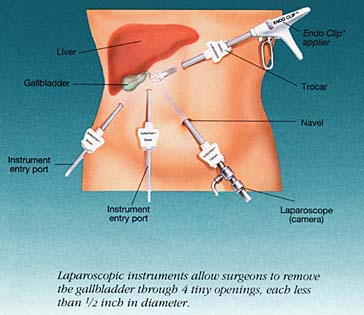
Today, with the laparoscopic gallbladder technique, removal can be accomplished
through only 4 tiny openings, each 1/4 to 1/2 inch in diameter.
How is laparoscopic gallbladder removal performed?
Laparoscopic gallbladder removal takes place under general anesthesia, so
the patient is asleep throughout the procedure. Using a trocar, (a narrow
tube-like instrument), the surgeon gains access into the abdomen through
the navel. A laparoscope (a tiny telescope) connected to a camera is inserted
through the trocar, giving the surgeon a view of the patient's internal
organs on a video monitor.
Three additional trocars are inserted into the abdomen to accommodate special
instrumentation. After the cystic artery (blood supply to the gallbladder)
and the cystic duct are identified, the surgeon seals them with an instrument
called the ENDO CLIP* applier and then cuts the vessels, freeing the gallbladder
for removal. Electrocautery or a laser is then used to detach the gallbladder
from the liver bed, and the bile and stones are suctioned out of the gallbladder,
deflating it like a balloon. Using special graspers, the surgeon gently
removes the gallbladder through the navel.
Following the procedure, the small incisions are closed with a stitch or
two or with surgical tape. Within a few months, the incisions are barely
visible.
What are the advantages of laparoscopic gallbladder removal?
By operating through 4 tiny openings instead of the traditional 6- to 9-inch
incision, most laparoscopic gallbladder patients have significantly less
postoperative pain, heal faster and return to normal activities sooner than
patients who have undergone traditional gallbladder surgery.
How long will I be in the hospital?
In most cases, patients leave the hospital the same day or the day after
laparoscopic gallbladder surgery. This compares with a 5- to 8-day stay
following the traditional procedure.
When can I go back to work?
Most patients can return to work in just 3 to 7 days following the laparoscopic
procedure. Patients undergoing the traditional procedure usually cannot
resume normal activities for 4 to 6 weeks.
Will I have a large scar?
No. By using laparoscopic techniques, the surgeon can avoid a large incision,
leaving the patient with only 4 tiny marks.
Is laparoscopic gallbladder surgery safe?
Numerous medical studies show that the complication rate for laparoscopic
gallbladder surgery is very low and comparable to the complication rate
for traditional gallbladder surgery when performed by a properly trained
surgeon. While there are risks associated with any kind of surgery, the
vast majority of laparoscopic gallbladder patients experience no complications
and quickly return to normal activities.
Since the widespread acceptance of the gallbladder procedure, surgeons have
applied the laparoscopic technique to a broad range of surgical procedures,
including hernia repair, hysterectomy, appendectomy and lung and bowel surgery.
It is important to remember that before undergoing any type of surgery,
whether laparoscopic or traditional, you should ask your surgeon about his
or her training and experience.
Is laparoscopic gallbladder removal right for me?
Although there are many advantages to laparoscopy, the procedure may not
be appropriate for some patients who have had previous lower abdominal surgery
or who have some pre-existing medical conditions. A thorough medical evaluation
by your personal physician, in consultation with a general surgeon trained
in laparoscopy, can determine if laparoscopic gallbladder removal is an
appropriate procedure for you.
home | surgeons
| nurses | hospital
administrators | reference room |
did you know? | about
USSC
* Trademark of United States Surgical Corporation

Copyright © 1997 United States Surgical Corporation. All Rights Reserved.
Contact webteam